2026.2 OnPremises Load Balance Installation Guide for Windows
In this article, we provide instructions to install qTest components for 2026.2 OnPremises on different Windows server machines with a Load Balancer, then connect it to qTest Manager on another machine. Please read the instructions thoroughly before starting your installations.
Complete the OnPremises Technical Services Request form (opens in new tab) to request assistance or obtain self-installation links, whether you're upgrading or performing a fresh install.
About the Command Line Wizard
The qTest 2026.2 Command Line Wizard is a command line interface application that allows you to configure basic settings for qTest applications in your purchase package.
You should understand these Command Line Wizard characteristics before you begin:
-
For each step, the installer will prompt you for a specific input value. After you provide a value, the installer will validate the input. If the value is incorrect, or additional permissions are required, an explicit error message displays so it’s easy to know how the input value should be corrected.
-
Default values display in square brackets [ ]. To use the default value, simply hit the Enter key.
-
Input values for yes/no questions, should be 'y', 'yes','n', 'no' (ignore case sensitive.) Any value other than those listed will be treated as a 'no.'
-
-
To terminate the configuration at any time without completing it, press Ctrl+C.
In the event, you cannot start the Command Line Wizard again after terminating the configuration, backup then remove the qTest.config file. Retry to start the Command Line Wizard again.
Before You Begin
These instructions are specific to deploying qTest applications on a Windows Server 2019/2022 environment. If you are installing qTest applications with load balancing on another Windows version, please consult our customer support.
Read the following:
Note that the Command Line Wizard will prompt you for each installation instruction. You need to perform action items and gather specific connection information before you begin the installation process. Use the application checklist below to ensure you have all the required values readily available.
TLS Connections
Client connections for qTest and PostgreSQL will be configured to use transport layer security (TLS) by default. However, the option to use non-TLS (HTTP) connections is still available at your own risk. A self-signed certificate is provided for convenience, but Tricentis recommends a CA-signed certificate whenever possible.
Ports
Open the Ports for the prerequisite applications and qTest applications you are installing prior to any self-assisted installation or upgrade. You should only open the HTTPS ports if you plan to serve SSL from the application.
Suggested application ports are listed below, but you can choose to use a different port for the qTest applications you install.
Prerequisite applications
|
Product |
Port |
Transport Protocol |
Application Protocol |
Source |
Destination |
Configurable |
|---|---|---|---|---|---|---|
|
PostgreSQL |
5432 |
TCP |
TCP |
qTest Manager, Insights, Sessions, Parameters |
Database (PostgreSQL) Server |
Yes |
|
Elasticsearch |
9200 (TCP) 9300 (if using ES Clustering) |
TCP |
HTTP |
qTest Manager |
Database (Elasticsearch) Server |
Yes |
|
Network File System (NFSV4) |
2049 |
TCP/UDP |
TCP/UDP |
qTest Manager, Sessions |
NFS |
No |
Native Linux and Windows
|
Product |
HTTPS Port |
HTTP Port |
Transport Protocol |
Application Protocol |
Source |
Destination |
Configurable |
|---|---|---|---|---|---|---|---|
|
Manager/API |
443 |
80 |
TCP |
HTTPS |
Web Browser, API |
qTest Manager Application Server/API Server |
Yes |
|
Sessions |
8443 |
8080 |
TCP |
HTTPS |
Web Browser, API |
qTest Application Server |
Yes |
|
Scenario |
6443 |
6080 |
TCP |
HTTPS |
Web Browser, API |
qTest Application Server |
Yes |
|
Insights |
9443 |
9080 |
TCP |
HTTPS |
Web Browser, API |
qTest Application Server |
Yes |
|
Parameters |
5443 |
5080 |
TCP |
HTTPS |
Web Browser, API |
qTest Application Server |
Yes |
|
Pulse |
4443 |
4080 |
TCP |
HTTPS |
Web Browser, API |
qTest Application Server |
Yes |
|
Launch |
3443 |
3080 |
TCP |
HTTPS |
Web Browser, API |
qTest Application Server |
Yes |
Please note that we strongly recommend that you use the HTTPS ports in your setup.
Application Checklist
You will need to gather the following information for each application prior to beginning the installation and configuration.
PostgreSQL 16.x - Must be installed and configured prior to qTest application installation. You must inst
-
Hostname/IP
-
Port
-
Database Superuser - You can use the standard PostgreSQL user. If you require a separate user, it must have equivalent superuser permission. Your PostgreSQL setup must have superuser access, so you can't use managed PostgreSQL services that don't grant native superuser access. Learn more about the limitations of managed cloud PostgreSQL services in our Knowledge Base (opens in a new tab).
-
Database Superuser Password
-
TLS Certificate - The location of the TLS root certificate is required for installation. Make sure that the permissions and ownership allow the user installing qTest to access the path and certificate files recursively. For more information on PostgreSQL TLS connections, refer to the official documentation found at https://www.postgresql.org/docs/current/ssl-tcp.html.
Elasticsearch 7.17.x - Must be installed prior to qTest application installation
-
Hostname/IP
-
Port
-
TLS Certificate - The location of the TLS root certificate is required for installation. Make sure that the permissions and ownership allow the user installing qTest to access the path and certificate files recursively. For more information on Elasticsearch TLS connections, refer to the official documentation found at https://www.elastic.co/guide/en/elasticsearch/reference/7.x/ssl-tls.html.
TLS Configuration
-
qTest and PostgreSQL
-
Cipher suite - the list of cipher suites the program uses in the ssl_ciphers.config file.
-
The server uses a default set of cipher suites in the ssl_ciphers.config file, but you can edit the configuration file to provide your own. The configuration file contains cipher format examples and details on how to provide your own ciphers.
-
-
Certificate Authority (CA) Signed Certificate –Will be inserted into the qTest Java Keystore. Use PKCS #8 format. May be signed by an internal CA. Must have a fully qualified domain name and resolvable DNS alias, with valid creation and expiration dates. Use the absolute path to certificate location on the server. The user executing the qtestctl installation must also have read permission for this file and path recursively.
-
Private Key - Use the absolute path to certificate location on the server. The user executing the qtestctl installation should also have read permission for this file and path recursively. If a passphrase is used for the private key, make sure to have it available.
-
This information is only needed if you will be deploying with an SSL secured connection:
qTest Applications
-
Certificate File (.crt) - absolute path to the certificate file on this server.
-
Location should not be inside the directory tree of the qTest application (i.e. /qtestctl). The user executing the qtestctl installation must also have read permission for this file and path recursively.
-
-
Private Key (.key) - absolute path to the private key file on this server.
-
Location should not be inside the directory tree of the qTest application (i.e. /qtestctl). The user executing the qtestctl installation must also have read permission for this file and path recursively.
-
-
Private Key passphrase
qTest Applications
-
Manager
-
Port to be used for communications (HTTP or HTTPS)
-
Local Disk directory for attachment storage – Location should not be inside the directory tree of the qTest application (i.e. /qtestctl). The user executing the qtestctl installation should also have read permission for this file and path recursively.
- OR -
Amazon (AWS) S3 for attachment storage - Requires bucket name, access key, region, and secret key. For a procedure on setting up AWS S3 for attachment storage, refer to Create an AWS S3 Bucket for qTest Attachment Storage.
-
Directory to logging storage - Location should not be inside the directory tree of the qTest application (i.e. /qtestctl). The user executing the qtestctl installation should also have read permission for this file and path recursively.
-
Fully Qualified Domain Name, Hostname, or IP Address to construct the application URL – This must be resolvable outside of the server.
-
Secret key – You can generate the first key from the installation wizard. After you generate a secret key, make sure you save and use the same key for all of your qTest applications, on all instances.
-
Integration secret key – You can generate the first key from the installation wizard when you install qtestctl. After you generate a secret key, make sure you save this key in a safe place. You must use the same key for all nodes that run Manager or Launch during installation and upgrades.
-
-
Sessions
-
Port to be used for communications (HTTP or HTTPS)
-
Storage type and location for resource files
-
Disk storage – Local disk, NFS, or NAS
-
Amazon S3 – Requires Bucket Name, Access Key, and Secret Key
-
-
Enhanced CSRF Security (Optional)
-
Resolvable URL and Port for qTest Manager
-
Resolvable URL and Port for qTest Sessions
-
Resolvable URL/Domain for external defect tracker (e.g. – JIRA)
-
-
Secret key – You can generate the first key from the installation wizard. After you generate a secret key, make sure you save and use the same key for all of your qTest applications, on all instances.
-
-
Insights
-
Port to be used for communications (HTTP or HTTPS)
-
Directory for custom report and dashboard files - Location may be inside the directory tree of the qTest application (i.e. /qtestctl). The user executing the qtestctl installation should also have read permission for this file and path recursively
-
Enhanced CSRF Security (Optional) –
This may affect Insights performance and features such as (Embedded Reports/Dashboard, Shareable Dashboard, and Rapid Dashboard)
-
Resolvable URL and Port for qTest Manager
-
Resolvable URL and Port for qTest Sessions
-
-
-
Parameters
-
Port to be used for communications (HTTPS)
-
Secret key – You can generate the first key from the installation wizard. After you generate a secret key, make sure you save and use the same key for all of your qTest applications, on all instances.
-
-
Launch
-
Port to be used for communications (HTTPS)
-
Fully Qualified Domain Name, Hostname, or IP Address to construct the application URL – This must be resolvable outside of the server
-
Integration secret key – You can generate the first key from the installation wizard when you install qtestctl. After you generate a secret key, make sure you save this key in a safe place. You must use the same key for all nodes that run Manager or Launch during installation and upgrades.
-
-
Pulse
-
Port to be used for communications (HTTP or HTTPS)
-
Fully Qualified Domain Name, Hostname, or IP Address to construct the application URL – This must be resolvable outside of the server
-
Directory to logging storage - Location should not be inside the directory tree of the qTest application (i.e. /qtestctl). The user executing the qtestctl installation should also have read permission for this file and path recursively
-
Resolvable URL and Port for qTest Manager
-
Choose which version of the Pulse Executor to install
-
-
Scenario
-
Port to be used for communications (HTTP or HTTPS)
-
Fully Qualified Domain Name, Hostname, or IP Address to construct the application URL – This must be resolvable outside of the server
-
Secret key – You can generate the first key from the installation wizard. After you generate a secret key, make sure you save and use the same key for all of your qTest applications, on all instances.
-
Install qTest Applications with a Load Balancing Model
Refer to the Server Sizing Guide to view different deployment model samples.
To use this sample load-balancing model, you'll need to install and configure multiple qTest applications using the same qTest Application Installation Package. For example, you'll have qTest Manager and Sessions application nodes on at least two separate servers, and you'll also install any satellite applications on a third server.
The sample below uses 7 servers:
-
1 load balancing server for Manager
-
2 qTest Manager + Sessions servers
-
1 qTest Satellite Application Server
-
1 qTest Manager API server
-
1 database server
-
1 shared storage server
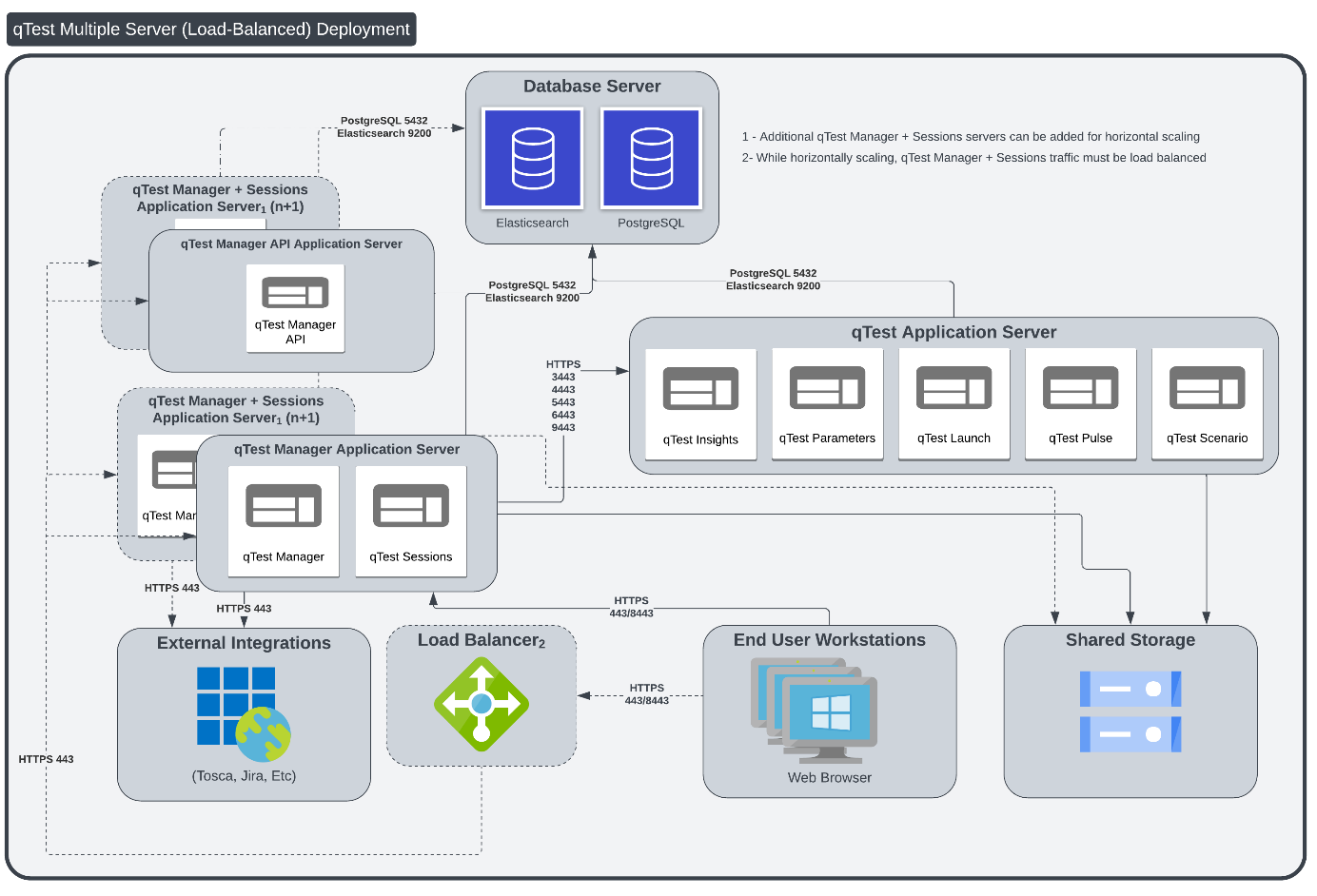
Sample load-balanced deployment for qTest.
-
Server 1: This is the server that load balances the two qTest Manager and qTest Sessions servers. We'll install and use NGINX on this server for that purpose.
- Server 2:
This is one of two qTest Manager Application servers.
qTest Manager application node: An instance of qTest Manager deployed in a Windows server
qTest Sessions application node: An instance of qTest Sessions deployed in a Windows server
NFS Client: Accesses the shared storage on the NFS Server
-
Server 3: This is one of two qTest Manager Application servers.
-
qTest Manager application node: An instance of qTest Manager deployed in a Windows server
-
qTest Sessions application node: An instance of qTest Sessions deployed in a Windows server
-
NFS Client: Used to access the shared storage on the NFS Server
-
-
Server 4: This is the satellite application server, which contains all applicable qTest satellite applications.
-
qTest Insights application node: An instance of qTest Insights deployed in a Windows server
-
qTest Parameters application node: An instance of qTest Parameters deployed in a Windows server
-
qTest Launch application node An instance of qTest Launch deployed in a Windows server
-
qTest Pulse application node: An instance of qTest Pulse deployed in a Windows server. Make sure you know which version of the Pulse Executor you want to install.
-
qTest Scenario application node: An instance of qTest Scenario deployed in a Windowsserver
-
-
Server 5: This is used to handle API traffic.
-
An instance of qTest Manager deployed in a Windows server
-
- Server 6: This is the server that contains prerequisite applications, including PostgreSQL, Elasticsearch and the Shared Network Drive.
PostgreSQL: A database engine used to manage qTest Manager, Sessions, Parameters, Insights, and Launch. All application nodes must use the same PostgreSQL database.
Elasticsearch: A database engine used for enhanced search capabilities
Shared Server: A server that hosts shared components that are required to run qTest Manager and Sessions. It should be accessible from all application nodes to store attachments and search index.
-
Server 7 (Optional): This is the server that contains your shared storage. Depending on your setup preferences, you can install shared storage with other prerequisite applications on Server 6.
-
NFS Server (Network File Systems): Used to share directories and files with others over a network. We'll use NFS to manage and share files created by qTest Manager and Sessions applications deployed on the two qTest Manager and qTest Sessions servers.
You will need to configure the application nodes with your load balancer. You can use any load balancing tools or services which are being used in your organization. Our sample uses HAProxy. Your team members will access qTest Manager via the URL in the application nodes as configured in the load balancer.
-
Setup Shared Network Drive and Install NFS Server
You will need to create a directory under a shared network drive which is accessible from all application nodes. Refer to Set up a shared directory using NFS (Windows) for instructions on setting up your shared network drive using NFS.
Files that may need to be shared among services can be supported by a distributed file system like NFS or SMB.
Install an Application Node
Installing an application node follows the same instructions as installing a qTest application on a single server. Refer to Download and Start the Installation Package for instructions on installing a single node. You can add as many nodes as you need.
As described in the sample load balancing diagram above, there is one Manager application node on one server, one Sessions node on one server, etc. For these single application installations, you will answer appropriately in the Command Line Wizard for the applications to install on that single machine. Therefore, if you are installing only Manager on one server, then you will answer 'yes' for Manager, but 'no' for all other applications when prompted in the Command line Wizard.
Additional Configuration for Sessions Node in a Load Balanced Environment
If you meet ALL of the following conditions, please read Additional Sessions 2026.2 Load Balance Configuration Windows/Linux before restarting your server for an additional configuration step on your Sessions application node:
-
Load balancing qTest Sessions 2026.2
-
Using F5 Load Balancer
-
Using Internet Explorer to access qTest Sessions
Restart Server
You will need to restart the server for the changes to take effect, then move on to installing the next qTest application.
Repeat Application Installations
You will need to repeat the steps in Download and Start the Installation Package and Install qTest Applications as a Windows Service for each server that contains one or more applications. (You can add as many application nodes as you need for your team size. In this example, we have 2 Manager and 2 Sessions application nodes.)
(Manager and Sessions Only) Server Requirements
Before you download the application installation package you will need to Install NFS Client for Windows on your Manager and Sessions servers. Use the NFS client to mount the shared folder, which you have set up in a Shared Server, to a local drive. The local drive will be used to configure qTest Manager and Sessions when you install it.
In our sample deployment model above, the application installation steps would need to be completed eight times: once for each application node:
-
Server 2: qTest Manager application node, qTest Sessions application node and NFS Client.
-
Server 3: qTest Manager application node, qTest Sessions application node and NFS Client.
Setup qTest Manager Load Balancer
Now, it's time to load balance. You will need one server to install load balancing software.
-
Server 1: qTest Manager Load Balancer
You will need to use any proxy tools (such as HAProxy, NGINX) which are available in your organization to configure the Load Balancer.
In our example, we will install and configure NGINX on a Windows server whose public IP address is 54.92.55.101.
In this example, we use NGINX to load balance qTest Manager and Sessions applications deployed on two Windows servers. However, you could choose to install your preferred load balancing software and follow the instructions of the software vendor to configure.
Download NGINX
-
Access the Windows server where you will install NGINX.
-
Download NGINX 1.13.0 here.
-
Extract the downloaded NGINX package to C:\NGINX-1.13.0
Configure NGINX
-
Open the NGINX configuration file at C:\NGINX-1.13.0\conf\NGINX.conf
-
Edit the file as seen below (notice the highlighted configuration in bold).
It is highly recommended that you copy and paste all of the content below to your NGINX.conf file. Replace blue text with actual values. Only information listed out here needs to be updated. Other information should remain unchanged.
#user nobody;
worker_processes 1;
#error_log logs/error.log;
#error_log logs/error.log notice;
#error_log logs/error.log info;
#pid logs/NGINX.pid;
events {
worker_connections 1024;
}
http {
include mime.types;
default_type application/octet-stream;
#log_format main '$remote_addr - $remote_user [$time_local] "$request" '
# '$status $body_bytes_sent "$http_referer" '
# '"$http_user_agent" "$http_x_forwarded_for"';
#access_log logs/access.log main;
sendfile on;
#tcp_nopush on;
#keepalive_timeout 0;
keepalive_timeout 65;
#gzip on;
upstream application_servers {
server IP address and port of server 2;
server IP address and port of server 3;
}
server {
listen 80;
server_name localhost;

#charset koi8-r;
#access_log logs/host.access.log main;


location / {
proxy_pass http://application_servers;
proxy_redirect http://$http_host $scheme://$http_host;
proxy_set_header Host $http_host;
proxy_set_header X-Real-IP $remote_addr;
proxy_set_header X-Forwarded-For $proxy_add_x_forwarded_for;
proxy_set_header X-Forwarded-Proto $scheme;
proxy_set_header X-Forwarded-Host $http_host;
}
}
Configure the Proxy Tool to Start at Windows Start Up
Our instructions below use NGINX as the sample proxy tool.
Create a batch file that will start NGINX when it is executed by following the steps below:
-
Navigate to the folder C:\NGINX-1.13.0\.
-
Create a file named startup.bat.
-
Enter the following information in the file start NGINX.exe.
-
Save and close the file.
-
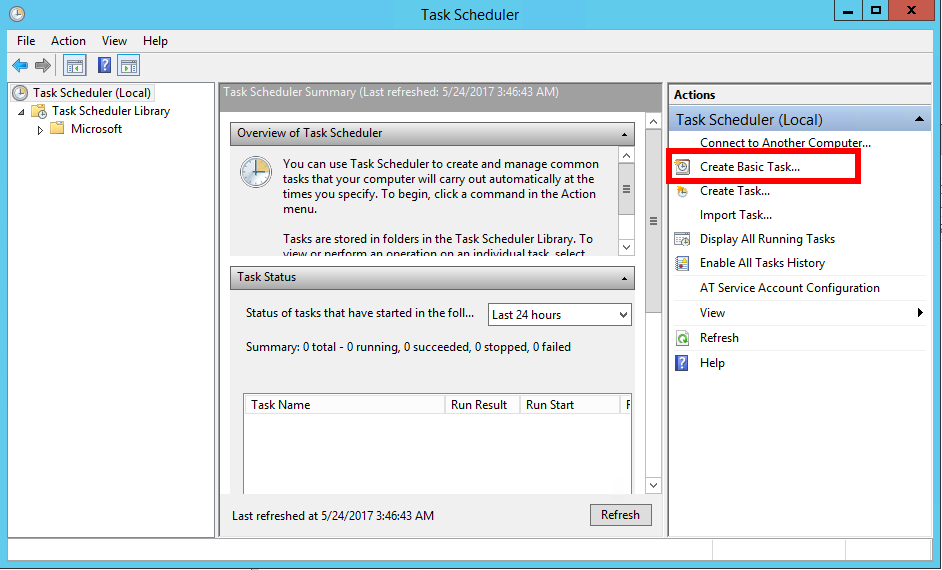
Open Task Scheduler and select Create Basic Task in the Actions panel on the right.
-
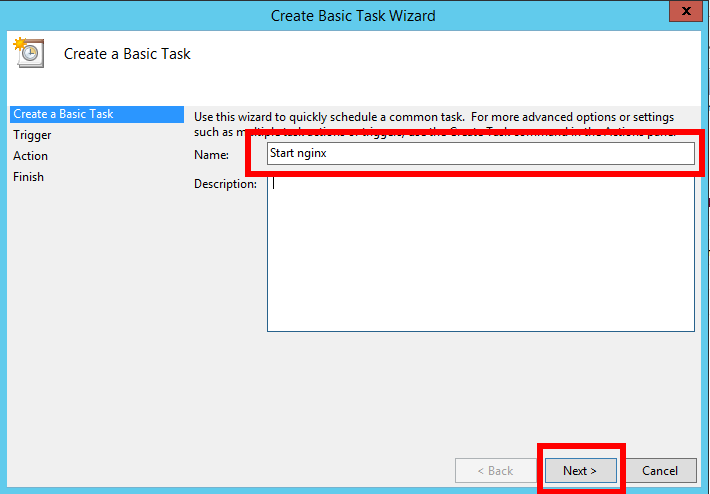
On the Create Basic Task screen, enter Start NGINX in the Name field. Then select Next.
-
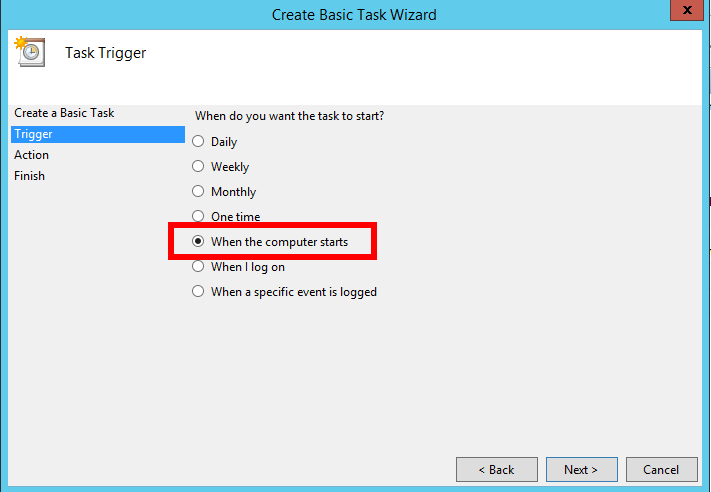
On the Task Trigger screen, select the When the computer starts option button. Then select Next.
-
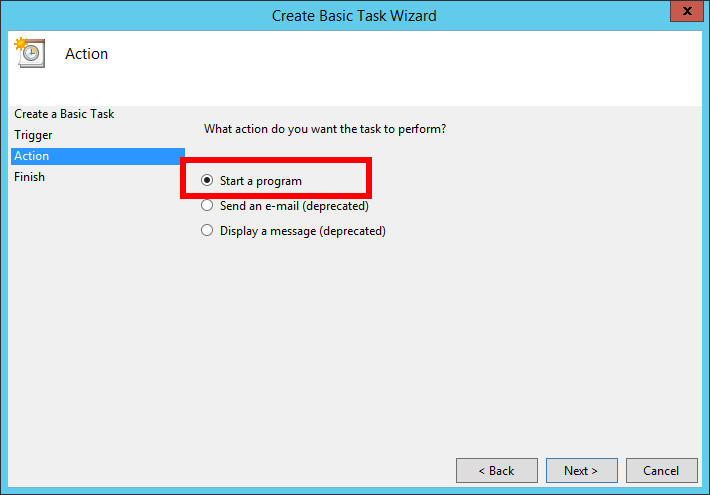
On the Action screen, select the Start a program option button. Then select Next.
-
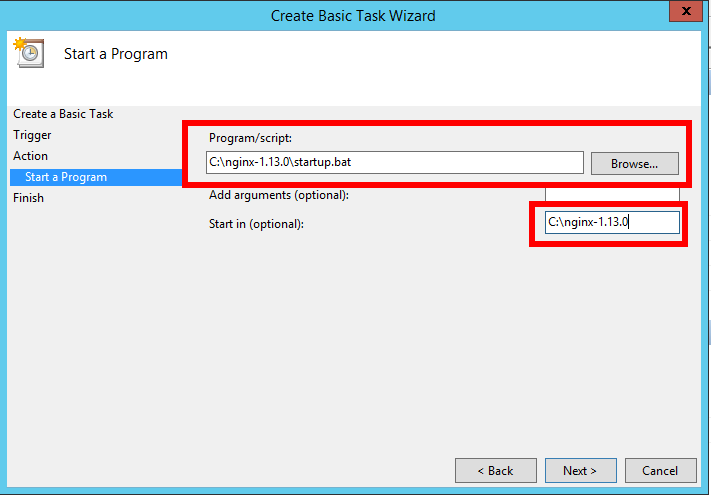
On the Start a Program screen, enter the following. Then select Next.
-
Program/script: C:\NGINX-1.13.0\startup.bat
-
Start in (optional): C:\NGINX-1.13.0
-
-
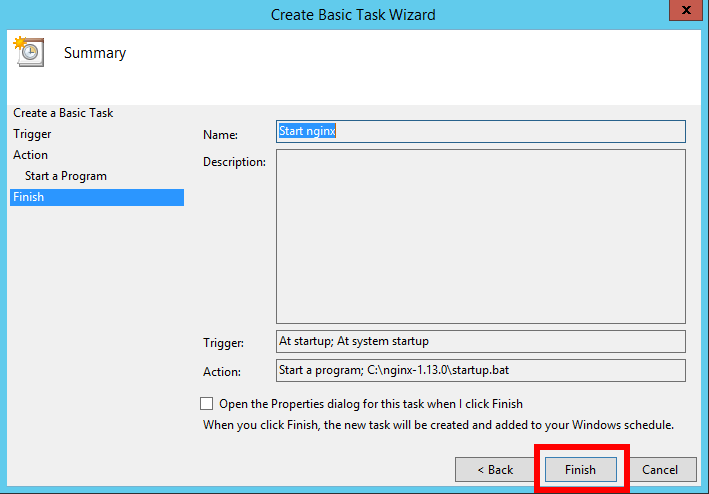
On the Summary screen, click Finish.
-
You will be taken back to the Task Scheduler screen.
-
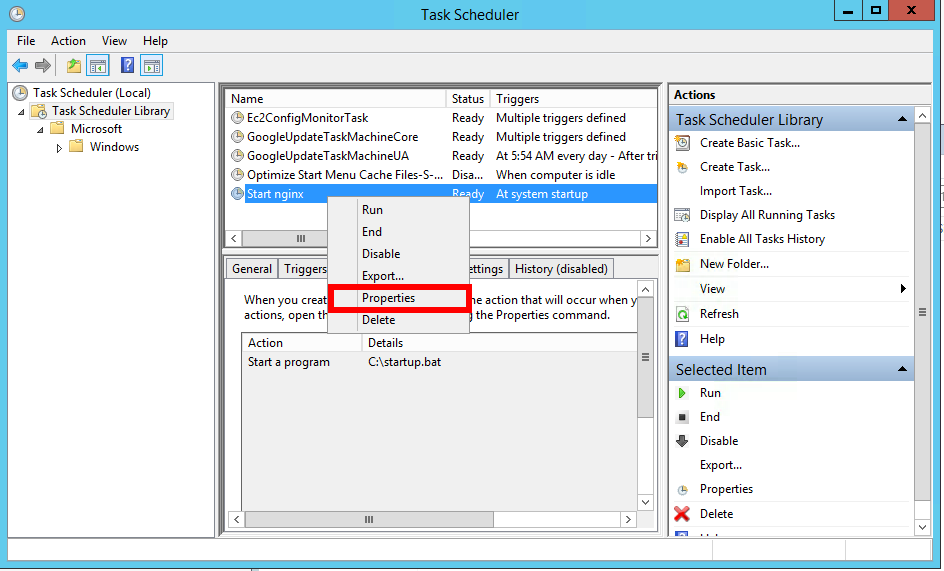
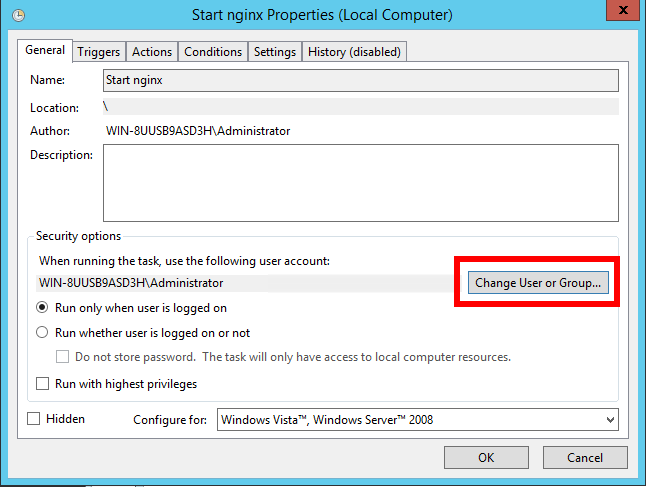
Select the Task Scheduler Library item in the left panel. In the middle panel, locate the task you just created with the name "Start NGINX". Right click the item, and then select Properties from the right-click menu.
-
On the Properties window, select Change User or Group.
-
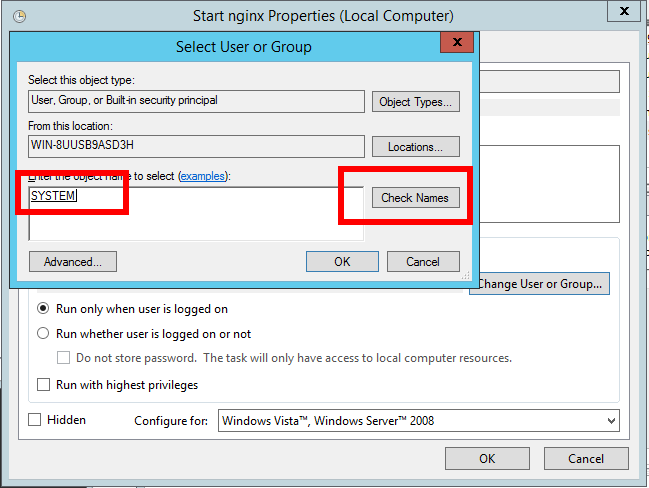
On the Select User or Group window:
-
Enter System in the Enter the object name to select field.
-
Select Check Names.
-
Select OK.
-
-
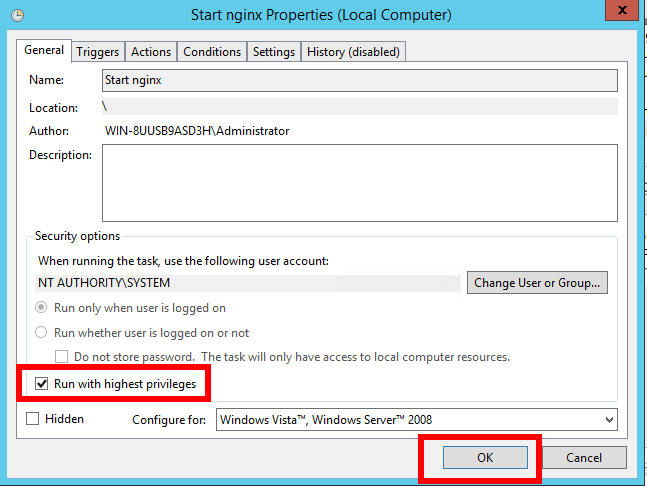
You will get back to the Properties window.
-
Check the Run with highest privileges check box. Then click OK.
-
You have finished setting up the load balancer with NGINX and configured it to load balance the two qTest Sessions instances.
Configure qTest Manager to Connect to qTest Applications
Follow the Configure qTest Applications guide to connect qTest Manager with the other qTest applications you installed. Load Balancing instructions are supplied for the applicable applications.
After setting up the Load Balancer, your users will access qTest Manager and Sessions using the URL configured in the Load Balancer. You should also verify that the applications can be accessed and working properly before performing the next and final step.
Switch to PostgreSQL search
Optionally, you can switch from Elasticsearch to PostgreSQL search after you install or upgrade OnPremises and your program is finished with initial indexing. PostgreSQL search is more stable and secure, but there are still a few known issues that we're currently working on.
To switch to PostgreSQL search, you'll need to update some variables in your qtestctl folder. You'll need to turn off Elasticsearch indexing, turn on PostgreSQL indexing, and switch the user interface to the PostgreSQL index.
Note that you can choose to have Elasticsearch and PostgreSQL perform indexing at the same time, but it will incur additional processing costs. We suggest that you choose one or the other, instead of running both.
Enable PostgreSQL search
Initial indexing can take anywhere from a few minutes to a few days, depending on the size of your data and your processing power. While qTest does send a notification when indexing is done, if you miss this notification, you can check your main.log file to find out if your instance is done with initial indexing. Just go to opt/qtestctl/manager/build/logs and locate the main.log file. When indexing is finished, this log will display the following message: "Sending indexing completion notification to users".
After initial indexing, if you're ready to start using PostgreSQL, follow these steps:
-
Stop the qTest Manager instance with the following command:
systemctl stop qtest -
Find your qtestctl folder. By default, this is located in
C:\qtestctlfor Windows. -
Open the following file:
qtestctl/manager/build.gradle. -
This file contains the instructions to initialize qTest Manager. Locate the
DB_PASSlist, which should look like this:CopyDB_PASS: "${Crypto.decryptString(config['manager.postgres.auth.pass'])}",
'manager.test.configuration': configEnabled,
S3_SECRET_KEY : Crypto.decryptString(config['manager.storage.s3.secretkey']),
SSL_PASS: sslPass,
SECRET_KEY: "${Crypto.decryptString(config['common.data.secretkey'])}",
AES_SECRET_KEYS: "${Crypto.decryptString(config['common.data.passwordsecretkeys'])}"
]) -
Add the following variables to the
DB_PASSlist:CopyDB_PASS: "${Crypto.decryptString(config['manager.postgres.auth.pass'])}",
'manager.test.configuration': configEnabled,
'qtest.elastic.search.replacement' : true,
'qtest.index.elastic.search' : false,
'qtest.index.Postgres' : true,
S3_SECRET_KEY : Crypto.decryptString(config['manager.storage.s3.secretkey']),
SSL_PASS: sslPass,
SECRET_KEY: "${Crypto.decryptString(config['common.data.secretkey'])}",
AES_SECRET_KEYS: "${Crypto.decryptString(config['common.data.passwordsecretkeys'])}"
]) -
Save your changes to the file to apply them.
-
Start your qTest Manager instance with the following command:
systemctl start qtest
Note that, if you update all of these environment variables at once, your search function won't return results until PostgreSQL is done indexing. To avoid this, you can turn on PostgreSQL indexing with the 'qtest.index.PostgreSQL' : true variable. When PostgreSQL is done indexing, you can then switch the user interface to this index with the 'qtest.elastic.search.replacement' : true variable. However you decide to perform these configuration tasks, be sure to restart qtestctl for each configuration change.
Verify PostgreSQL is active
After you've updated the qtestctl file, you can verify that PostgreSQL is functioning properly by reviewing the feature flags in Chrome.
Follow these steps to verify PostgreSQL:
-
Open your Manager instance in Chrome, then navigate to the developer console. You can find this by right-clicking anywhere on the website and selecting Inspect from the dropdown.
-
Navigate to the Console tab and enter the following command to view an expandable map of all the qTest feature flags:
qtest.featureFlags -
Locate the following feature flags and verify that they match these listed states:
qtest-elastic-search-replacement: { boolVariation: True }: If this is set to true, the search results in the user interface are from the PostgreSQL index. If it is false, the results in the user interface are from the ElasticSearch index.-
qtest-index-elastic-search: { boolVariation: False }: If this is set to false, Elasticsearch is not performing the indexing. -
qtest-index-PostgreSQL: { boolVariation: True }: If this is set to true, PostgreSQL is indexing.
If everything matches, you've successfully switched the backend of your search functions to PostgreSQL.