View Datasets - Retrieval results
When a Retrieve View action is run, the associated View dataset is populated with objects representing the table data retrieved. View datasets have the following structure:
<Dataset Name> (View Dataset)
<Table 1>
<Table N>
Entities
 <Dataset
name> (View Dataset)
<Dataset
name> (View Dataset)
When the root object is selected from a View dataset that contains retrieval results, the Details pane shows the number of rows retrieved from each table view in the dataset.

 Tables
The View dataset contains a Table object for each table alias in the View Definition where the usage type is set to MAIN. Each Table object has the name of the corresponding SAP table. If a table has more than one alias, the table object shows each alias name in square brackets.
When a table object is selected in a View dataset, the Details pane displays a grid control showing the compared values. The columns in the grid control may be resized by dragging the resize handles in the column headings. With the exception of the first column, a column may be expanded or contracted by double-clicking the handle on its right.
The grid control has column headings for each of the table fields compared, and two additional columns. The first column indicates the comparison status for the row, and the second column contains the SAP System ID for each of the compared systems.
Row data is matched based upon the ID Columns specified for the table view in the associated View Definition. These columns are marked with ‘*’ in the grid control. If the table view includes columns from an additional table (specified using an ‘Add’ section in the View Definition), the additional columns are marked with ‘+’.
The grid control uses the following display conventions:
- Underlined values indicate ID columns for the table. Click an underlined value to open the Row Details screen, which displays field values and descriptions for the selected row.
- Values shaded in green indicate key fields.
- Selected cells are shaded in gray.
Entities
The View dataset includes a single Entities object which links each of the tables in the dataset according to the parent-child relationships specified in the View Definition.
When the Entities object is selected, the Details pane displays a grid control showing the rows retrieved from the parent table specified in the View Definition. Click an underlined value to display the Row Details screen. This displays the selected row from the parent table and any related rows from each of the child tables.
A range of cells may be selected in the grid control by using Left Click+Drag in the column headings, row headings or table body. Alternatively, use Shift+Arrow keys to select cells using the keyboard. To select the entire table, choose ‘Select All’ from the grid control’s context menu. To clear a selection, choose ‘Clear All’ from the context menu, or click the cell labeled # in the top left-hand corner of the grid control. The following keyboard shortcuts may also be used
- Page Up scrolls the display up by one page.
- Page Down scrolls the display down by one page.
- Home selects the first cell in the current row.
- End selects the last cell in the current row.
- Ctrl+Home selects the first cell in the current column.
- Ctrl+End selects the first cell in the current column.
To export the selection to an Excel spreadsheet, choose ‘Copy Selection to Excel’ from the grid control’s context menu. To copy the selection to the Windows Clipboard, choose ‘Copy’ from the context menu, or press Ctrl+C. If a column is selected, all the column rows are copied, not just the rows that have been loaded into the grid control.
 Options
Click the ‘Options’ icon to show or hide the Options dialog:
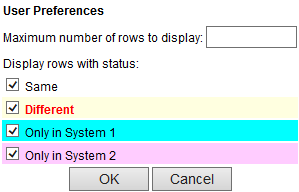
Enter a maximum number of table rows to display in the ‘Maximum number of rows to display:’ field. This value applies to all tables viewed by the current user, and is also stored in the ‘Maximum number of rows/objects to display:’ User preferences field.
Click ‘OK’ to save your changes.
 Export to
Excel
Export to
Excel
Click the ‘Export to Excel’ icon to export the contents of the selected Table or Entities object to an Excel spreadsheet named <Table Name>_<YYYYMMDD_HHMMSS>.xls or Entities_<YYYYMMDD_HHMMSS>.xls.